
Since the readings were TBA and we plan to watch Detropia in class the following week, I chose to write my blog entry on Thomas Sugrue’s lecture: “To Understand Race and Economics in America, Study Detroit.” As a historian himself, it did not surprise me that Sugrue started his presentation explaining the conventional wisdom of Detroit: how until the 1960s and 1970s, the city was booming due to the automobile industry; immigrants and refugees fled to Detroit; and it was a location where the “blue collar worker made it into the middle class.” Initially, I found this interpretation more romanticized than I had anticipated but I agreed how, in its “prime”, Detroit was unstoppable and very successful. In fact, I remember coming across a statistic that said Detroit, at one point, had over 1.6 million residents, but now there are less than 700,000 residents who live there.
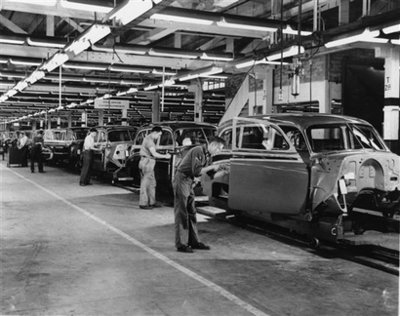
What I found fascinating (and almost disturbing) about Detroit is what happened to the city after the auto industry collapsed. This, Sugrue points out, is a combination of federal public policies, union policies, corporate mismanagement, and racially divided politics; this is precisely where the intersection of race and economics come to play in Detroit’s history. Essentially, structural oppression from various institutions has exacerbated several forms of racial and economic inequalities. For example, Sugrue explains how the auto industry’s job loss fell disproportionately low on African-American workers because of the persistence of workplace discrimination. Black employees had the most physically demanding and low-paying jobs so they were given the boot much sooner than their white counterparts. But how much has that changed even today?

At the same time, however, minority workers faced oppression in several other areas like housing. I had no idea, for instance, that “powerful organizing of the home owner’s movement actively preserved the homogeneity of different racial neighborhoods”. As Sugrue explained, The Federal Housing Administration, the Home Owners Loan Corporation, and the Veterans Association intentionally excluded African-Americans from the conventional mortgage market due to overt racism. Perhaps this is why Detroit has consistently been one of the most racially segregated cities in the U.S. since the 1920s and remains there? Housing discrimination and injustices still occur in Detroit – the Delray article highlighting the Canadian bridge’s construction is a fitting example of this. Gentrification, like the “Untold Detroit” video highlights, also represents housing discrimination since development companies are displacing minority families who have lived in these now-gentrified locations their whole lives. Like I said earlier, it’s fascinating to see the connections from different readings, but it’s also disturbing.
In my opinion, what struck me the most was learning about the allocation (or lack) of resources through the real estate market and how that exacerbated racial inequality. Maybe Sugrue’s most profound figure was how “the average African-American household has $5000 in wealth, while the average white household has approximately $133,000 in wealth”. That is absolutely unjust and objectively unequal!! Sadly, this structural oppression is still relevant and alive today. On the other hand, I believe one way community-based social workers can promote social justice is by advocating for equal, fair, local housing policies. Systemic oppression is broad, but it’s possible to start small and make change within our communities. This, at the very least, is a great first step.


 Worldviews Welcome